

Procurement's AI Paradox: Can AI Double Your Strategic Sourcing Savings? | K2 Sourcing Nov 11, 2026
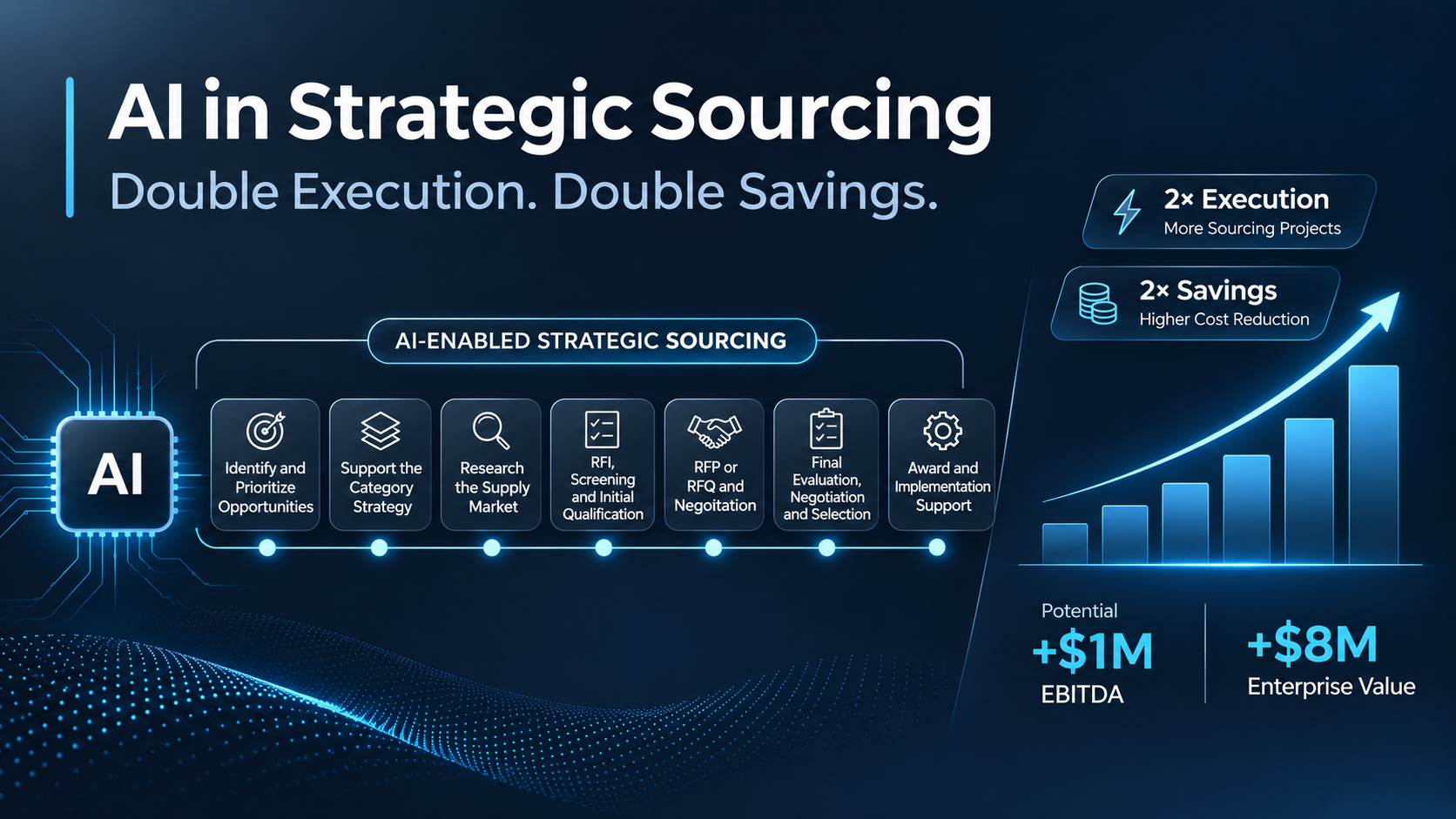
How AI can accelerate the seven steps of strategic sourcing, increase procurement capacity, and turn productivity gains into measurable financial results.
Artificial intelligence is transforming procurement. But the biggest financial opportunity may not be better spend analysis, faster supplier research, or even smarter negotiations.
It may be the ability to execute twice as many strategic sourcing projects with essentially the same resources.
Recent research from McKinsey, Deloitte, PwC, The Hackett Group, Kearney, and Art of Procurement points toward a common conclusion: AI has the potential to fundamentally change how procurement organizations operate.
And yes, K2 Sourcing competes with these consulting firms. We appreciate their research. We just operate with considerably less overhead.
In recent research, PwC suggests AI could reduce sourcing cycle times by 50% or more. The Hackett Group projects an 8% increase in procurement workloads despite declining resources. Meanwhile, research from Art of Procurement and HFS Research found that only 15% of surveyed procurement organizations have fundamentally redesigned their operations around AI, while 38% remain in pilot programs.
The opportunity is significant, but realizing it requires more than purchasing AI tools.
How Can AI Improve the Strategic Sourcing Process?
AI can improve strategic sourcing by accelerating spend analysis, supplier discovery, RFI and RFP development, proposal evaluation, negotiations, and implementation monitoring. However, its greatest financial benefit may come from increasing the number of sourcing projects a procurement team can execute without adding headcount. Combining AI with experienced procurement professionals helps organizations convert productivity improvements into realized cost savings.
Let's examine how AI can accelerate each of the seven steps of strategic sourcing while maintaining the human judgment, supplier engagement, and quality controls necessary to achieve meaningful results.
1. Identify and Prioritize Opportunities
AI can analyze thousands of purchasing transactions, supplier records, contracts, and market benchmarks to uncover potential procurement cost savings opportunities. It can identify pricing inconsistencies, supplier consolidation opportunities, and upcoming contract renewals in a fraction of the time previously required. However, the data rarely tells the entire story. Procurement professionals must engage internal stakeholders to understand operational challenges, changing business priorities, future requirements, and organizational constraints that may not appear in the data. AI can help identify opportunities, but stakeholder knowledge and business judgment determine which opportunities deserve priority. The result is a more comprehensive and actionable Supplier Savings Pipeline that reflects where the organization is going, not simply where it has been.
2. Support the Category Strategy
Developing a category strategy traditionally requires extensive research and analysis. AI can accelerate the process by examining spending patterns, supplier performance, commodity trends, market conditions, and sourcing alternatives. Experienced category managers then apply their expertise to evaluate tradeoffs, develop negotiation strategies, and align recommendations with business objectives. Less time gathering information means more time developing strategies that can deliver measurable financial results.
3. Research the Supply Market
Identifying qualified alternative suppliers is often one of the most time consuming parts of strategic sourcing. AI procurement tools can rapidly research domestic and international markets, identify manufacturers and distributors, review capabilities, and compare potential suppliers against sourcing requirements. However, supplier engagement, capability verification, and relationship development still require experienced sourcing professionals. AI can significantly expand the potential supplier universe while reducing the research effort required to find qualified competitors.
4. RFI, Screening and Initial Qualification
AI can help develop supplier questionnaires, review responses, compare qualifications, and identify missing information or potential risks. However, general purpose AI models can generate generic qualification questions that overlook an organization's specific technical, operational, and commercial requirements. They may also recommend unnecessary questions that create additional work for suppliers without improving the decision. Procurement professionals and internal stakeholders must refine these outputs to ensure the RFI focuses on what truly matters. The objective is a faster, more effective qualification process, not simply a longer questionnaire.
5. RFP or RFQ and Negotiation
AI can assist with developing RFPs, organizing specifications, preparing pricing templates, and analyzing supplier proposals. Combined with electronic sourcing platforms and reverse auctions, AI enabled procurement workflows can dramatically reduce administrative effort while increasing competitive pressure. However, AI generated RFPs may lack the category specific detail necessary to obtain accurate, comparable proposals. They can also introduce unnecessary requirements that discourage supplier participation. Experienced sourcing professionals must ensure the RFP reflects actual business needs, provides suppliers with the information necessary to quote, and minimizes unnecessary complexity.
Procurement Pro Tip: More questions do not necessarily produce better proposals. Asking suppliers to complete unnecessary requirements can reduce engagement and competition. For practical advice, read our article, Why Suppliers Are Dropping Out of Your RFP Before They Ever Quote.
6. Final Evaluation, Negotiation and Selection
AI can rapidly normalize supplier proposals, evaluate total cost of ownership, compare alternatives, and identify negotiation opportunities. Analysis that previously required days of spreadsheet work can potentially be completed in hours. However, AI needs more than general instructions to evaluate complex sourcing results effectively. Agents developed around proven sourcing methodologies, quality controls, and evaluation criteria can provide a more meaningful review. Procurement professionals still make the final recommendations, balancing financial benefits, operational requirements, supplier risks, and stakeholder priorities.
Want to see what a specialized sourcing AI agent can do? K2 Sourcing has developed an AI agent incorporating knowledge gained from thousands of sourcing events. We invite you to test our sourcing report review process at no cost. Read more and contact us for a free test drive > AI RFP Report Advice
7. Award and Implementation Support
Negotiated savings have little financial value until successfully implemented. AI can help compare contract terms against negotiated agreements, organize implementation plans, monitor milestones, and identify potential savings leakage. Human oversight remains critical for managing supplier transitions, stakeholder expectations, and organizational change. Accelerating implementation not only frees procurement resources for additional projects but also brings financial benefits into the business sooner.
How Much EBITDA Can Faster Strategic Sourcing Generate?
Consider a company with $100 million in addressable supplier spending. Its procurement team currently executes strategic sourcing projects covering 20% of that spending annually.
At an average 5% realized savings rate, those projects generate $1 million in annualized savings.
Now imagine AI enabled workflows allow the same procurement team to double its sourcing execution capacity, increasing annual coverage from 20% to 40%, without adding headcount.
The potential financial impact is substantial.
| Financial Measure | Current | With AI Enabled Execution |
| Annual addressable spend sourced | $20 million | $40 million |
| Realized savings rate | 5% | 5% |
| Annualized savings | $1 million | $2 million |
| Incremental annual EBITDA | +$1 million | |
| Potential added enterprise value at 8× EBITDA | +$8 million |
For the CFO, that is potentially $1 million in additional annual EBITDA and $8 million in enterprise value, without increasing procurement headcount.
And that is without assuming any improvement in savings percentages or negotiation outcomes.
These figures are illustrative, not a prediction. Doubling sourcing speed will not automatically double savings. Organizations must have sufficient addressable opportunities, supplier participation, stakeholder support, and implementation capacity. The EBITDA calculation assumes that the additional savings are recurring and flow through to operating earnings without offsetting costs. The 8× EBITDA valuation multiple is illustrative, and actual multiples vary by company and industry.
However, the financial opportunity is clear.
The goal is not merely to reduce the hours required to complete a sourcing project. It is to reinvest that capacity into additional opportunities that would otherwise remain untouched.
This is where AI productivity becomes measurable financial performance and potentially millions of dollars in enterprise value.
How K2 Sourcing Is Putting AI to Work
At K2 Sourcing, we are incorporating AI throughout all seven steps of our strategic sourcing process. We combine specialized AI agents, our Cloud Source technology, and experienced sourcing professionals to improve efficiency, strengthen quality controls, and accelerate project execution.
We are also happy to share examples of our AI agents so procurement professionals can experience how they work and evaluate potential applications within their own organizations.
Our philosophy is straightforward: Let AI handle more of the repetitive work so experienced sourcing professionals can concentrate on the activities that create the most value.
The Real Competitive Advantage Is Execution
The World Economic Forum and Kearney's 2026 report, The AI First Operating System, emphasizes the importance of redesigning workflows around AI rather than simply adding technology to existing processes.
McKinsey similarly argues that procurement organizations must rethink operating models and measure success through procurement ROI, including realized savings, avoided costs, and the resources required to achieve those results.
For procurement leaders, the implication is straightforwar half d.
AI can help identify more opportunities, reduce sourcing cycle times, improve analysis, and increase productivity. But the greatest financial value comes when those productivity gains are converted into additional sourcing projects and implemented savings.
That requires experienced sourcing professionals, effective technology, supplier competition, and sufficient execution capacity.
The next competitive advantage in procurement may not belong to the organization with the most sophisticated AI.
It may belong to the organization that uses AI to turn the most sourcing opportunities into actual financial results.
Your procurement team has a savings target. But how much additional savings could it deliver if execution capacity were no longer the constraint?
If You Like This Information
K2 Sourcing, an expert strategic sourcing company, provides solutions to increase procurement's capacity including our RFP application and reverse auction technology, managed RFP and reverse auction services, and complete strategic sourcing support for goods and services. Companies can use the strategic sourcing platform themselves, ask K2 Sourcing to manage events, or engage K2 Sourcing to facilitate the complete process from global supplier discovery through implementation.
Sign up for our monthly newsletter, The Procurement Pulse.
Follow K2 Sourcing on LinkedIn for weekly procurement tips and news.
Contact K2 Sourcing to discuss the eSourcing application or explore strategic sourcing services.
Research and Sources
This article draws on procurement and AI research published by several consulting organizations.